What is forex trading and how does it actually work for a beginner?
Want articles like this for your own video to promote it on YouTube and Google? Order them through the Telegram bot @sat_sit_bot. The bot writes and publishes the articles itself (with your YouTube video embedded) on popular topical websites (no ads). Your first 50 articles are free.
· based on the channel Matt Donlevey - Photon Trading
Key takeaways
- Forex is an over-the-counter market where currencies trade in pairs such as EUR/USD, priced by bid, ask and the spread between them.
- Price moves because of order flow: resting limit orders, market orders and the liquidity sitting above highs and below lows.
- Matt Donlevey's Photon Trading guide runs over three hours and covers market microstructure, auction market theory, structure, supply and demand, entries, risk and psychology.
- A trading edge is only half the job: money management, journaling and backtesting decide whether the edge survives contact with real money.
- Broker choice and trading costs (spread, commission, swap) directly reduce the return a strategy can produce.
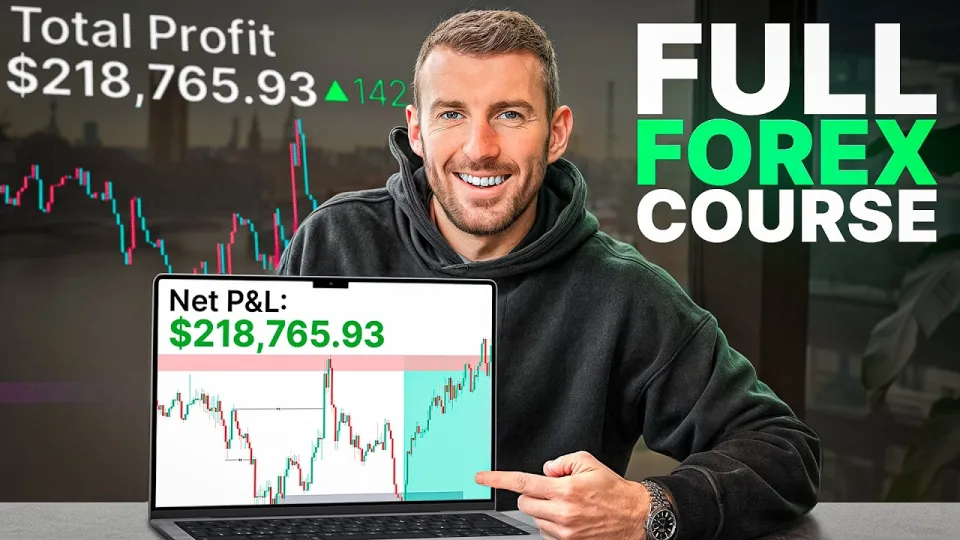
Forex is the global market where one currency is priced against another, and traders profit by buying a pair lower and selling it higher, or the reverse. It is not a prediction game about economies; it is a market of resting orders, and price moves when those orders are consumed. Matt Donlevey's Photon Trading beginner course, published as a single three-hour walkthrough, is built on exactly that premise, and the free Photon Trading course plus cheatsheets is available at the free training page.
What forex trading actually is and who is on the other side
Forex is an over-the-counter market with no central exchange, so every trade you take is matched by a broker's liquidity provider rather than by a single order book on a screen. The instruments are currency pairs: majors like EUR/USD and GBP/USD carry the tightest spreads, crosses like EUR/GBP are wider, and exotic pairs can be expensive enough to ruin a short-term strategy. Volume is enormous and continuous during the week, which is why the market is open from the Sydney session through Tokyo, London and New York.
The participants matter more than the charts. Banks, hedge funds, corporates hedging receivables and central banks set the tone, while retail traders are a small slice of daily turnover. That asymmetry explains why simple geometric patterns often fail: a triangle on a five-minute chart does not tell you where large resting orders sit. What does matter is who is forced to transact and where their stop losses and pending orders are clustered.
How price really moves: microstructure, order book and auction theory
Price is the record of transactions between buyers willing to pay the ask and sellers willing to hit the bid. Every quote has two sides, and the gap between them is the spread, which is a cost you pay on entry and again on exit. A tight spread on EUR/USD of a fraction of a pip is trivial; a three-pip spread on an exotic pair on a one-hour chart can wipe out the entire edge of a scalping system.
The order book adds the missing layer. Limit orders sit in the book waiting to be filled, market orders cross the spread and consume whatever liquidity is available. When a large market order sweeps through several price levels, price jumps and leaves a visible footprint. Auction market theory frames the same idea differently: the market continuously searches for a price where buyers and sellers agree, and it moves away quickly when one side is no longer interested. Order flow, the sequence of aggressive buys and sells, is the closest thing to a cause rather than a correlation.
For a beginner this changes how you read a chart. Instead of asking what shape a candle pattern forms, ask where the liquidity is, who is trapped, and what would have to happen for the other side to be forced out.
The Photon strategy framework: structure, premium and discount, supply and demand
Market structure is the skeleton of a directional read: a sequence of higher highs and higher lows defines an uptrend, and a break of the last higher low is the first evidence that the trend has changed. Donlevey separates structure into three types, which matters because a break of internal structure inside a range is not the same signal as a break of swing structure on a higher timeframe.
Premium and discount refine entries. If price is trading in the upper half of a dealing range, longs are expensive and shorts are discounted; the reverse applies in the lower half. Multi-timeframe analysis connects the two: the higher timeframe sets direction and the range, the lower timeframe provides the entry. Supply and demand zones mark prices where aggressive orders previously overwhelmed resting liquidity, and those areas are where the strategy looks for a reaction.
Liquidity concepts complete the picture. Equal highs, equal lows, session highs and round numbers attract stop orders, and price often trades into those pools before reversing. A practical sequence looks like this:
- Mark the higher-timeframe range and its premium and discount halves.
- Identify the current structure and the last point where it was broken.
- Locate supply or demand zones that overlap with a discount or premium area.
- Wait for price to sweep an obvious liquidity pool and show a reaction.
- Enter with a defined invalidation level and a stop beyond the zone.
Entries, trade management and money management in practice
An entry is only as good as the risk attached to it. Trade entries in a systematic approach are mechanical: a specific condition, a specific trigger, a specific stop, and a target defined before the position is opened. Trade management then decides whether to move the stop to break-even, take partial profits or let the position run, and each of those choices must be written down rather than improvised in the moment.
Money management is where most beginners lose. Risking a fixed small percentage of the account per trade, typically somewhere between 0.25% and 1%, keeps a losing streak survivable: ten consecutive losses at 1% risk cost roughly a tenth of the account, while the same streak at 10% risk is close to a wipeout. Position size follows from the stop distance, not from a feeling about the setup.
Three mistakes show up again and again: overtrading after a loss, moving the stop to avoid being wrong, and increasing size to recover. Each one converts a statistical edge into a random outcome.
Building a trade plan, backtesting and choosing a broker
A trade plan is a written document describing which pairs you trade, which sessions, which setups, how much you risk, and what disqualifies a trade. Without it, every decision is made under pressure, and under pressure people default to the behaviour that feels safest rather than the behaviour that is profitable.
Backtesting turns the plan into evidence. Manual backtesting over a few hundred historical setups, recorded with screenshots and outcomes, gives you a rough win rate and average reward-to-risk, which together tell you whether the edge exists at all. Forward testing on a demo account then checks execution and psychology before real capital is involved.
Broker selection deserves the same rigour. Check regulation and client-fund segregation, the real spread on your pairs during your trading session, commission per lot, swap rates for positions held overnight, execution quality around news, and whether the platform supports the order types your plan requires. Trading costs compound quietly: a strategy that earns 20 pips per trade on average behaves very differently with a two-pip all-in cost than with a six-pip one.
Journaling, psychology and the questions beginners keep asking
Trade journaling is the feedback loop that makes improvement possible: log the setup, the reason for entry, the risk, the result and, most importantly, whether you followed your own rules. Over a few months the journal shows whether losses come from a weak strategy or from broken discipline, and those two problems have completely different fixes.
Psychology is often taught in the wrong order. Discipline is much easier once a tested edge exists, because following rules then feels rational rather than hopeful. Traders who jump straight to mindset work while trading an untested system are trying to stay calm about something that does not work.
A few recurring concerns are worth answering directly. A three-hour course is dense, and some viewers find the pace fast, so watching it in sections and replaying the microstructure part is more effective than one sitting. Others ask whether such material can really be free; the answer is that the core concepts, structure, liquidity and risk, are standard and widely documented, and the value is in how they are sequenced. And the honest answer to how much you can make is that returns depend on edge, risk per trade and sample size, not on account size alone, and anyone quoting a fixed monthly percentage is selling something.
Useful links
- Free Photon Trading course and cheatsheets: https://www.photontradingfx.com/free-training?el=beginnersguide&htrafficsource=YT
- Photon Trading mentorship: https://www.photontradingfx.com?el=beginnersguide&htrafficsource=yt
- Free Telegram channel with analysis and trade recaps: https://t.me/photontrading
- Instagram: https://www.instagram.com/photontrading/
The bottom line on learning forex
Forex rewards traders who understand why price moves, not traders who memorise patterns. The path is unglamorous: learn microstructure and order flow, build structure-based setups, define risk in advance, backtest, journal, and only then scale. Matt Donlevey - Photon Trading condenses that path into a single long-form guide, and the free course at photontradingfx.com is the natural next step after watching it. Treat the material as a framework to test, not a promise of returns.
Source: Beginners Guide To Forex Trading In 2026 (+3 hours) · Markdown version
Questions & answers
How much money do you need to start trading forex?
You can open an account with a few hundred dollars, but the meaningful constraint is risk per trade, not the deposit. Risking 1% of a $500 account means $5 per trade, which is too small to be practical with normal lot sizes, so many beginners start on a demo account or with a micro-lot broker until the strategy is proven.
Is forex trading gambling?
It becomes gambling when position size and entries are decided without a tested rule set. With a defined setup, a fixed risk percentage and a recorded sample of trades, the outcome is a statistical distribution you can evaluate rather than a bet.
Why do so many beginners quit forex?
Most quit because they trade without a plan, oversize positions and then abandon the approach after a normal losing streak. A strategy with a genuine edge still produces runs of losses, and survivability depends on risk control, backtesting and journaling rather than on motivation.
Do you need technical analysis to trade forex?
You need a repeatable way to define entries, exits and invalidation, and technical analysis provides that language. What matters is grounding it in market mechanics such as liquidity, order flow and supply and demand, rather than in chart shapes alone.